01
What is vicuña?
Vicuña is the fibre of the vicuña, a wild camelid of the Andes. The animals live across some 250,000 km² of highland in Peru, Bolivia, Argentina and Chile, between 3,200 and nearly 5,000 metres; a small population lives in Ecuador. Cloth uses only the fine undercoat — 12.7 µm on average in adult animals.1, 2
02
Why is vicuña so rare?
Because the animals live wild and are shorn only when a community gathers them in a chaccu. One animal yields around 165 g of fleece per shearing; in Ayacucho, an animal is shorn about every three years. Around 7 tonnes of vicuña leave South America for export each year — for pure cashmere, the estimated annual quantity is around 6,500 tonnes.2, 3, 4, 5
03
Why is vicuña so expensive?
Little fibre per animal, long intervals between shearings, the careful separation of undercoat from guard hair, and a trade that documents every step. Even the raw fibre costs several times as much as good cashmere. And one running metre of our cloth weighs 420 g — more vicuña than two animals give at a shearing.4, 6, 2
04
How do I recognise genuine vicuña?
By the fibre content. What counts is the share of vicuña — “100% vicuña” or a blend with its share stated. Some cloth houses also use “Vicuna” as a colour name for cashmere; a colour name is not a fibre.7
By the selvedge. In international trade, it names vicuña and the country of origin. On our cloth, it reads “* SCABAL * 100% PURE VICUNA * VICUNA FIBRES FROM PERU”.8, 6
By the label. In international trade, vicuña garments carry a label with “VICUÑA” and the country of origin, such as “VICUÑA PERÚ” — and, if made elsewhere, the country of manufacture as well.9
By the documents. Ask for the invoice and the evidence of origin. With us, they are in your provenance file.
05
Vicuña or cashmere — what is the difference?
Vicuña is finer: 12.7 µm on average, against at most 19 µm for cashmere, whose finest qualities are around 14 µm. Vicuña comes from wild animals, and its trade is strictly regulated; cashmere is the undercoat of the cashmere goat, mainly from China and Mongolia. We make both to measure: cashmere coats from $5,900, vicuña coats from $31,000.2, 10, 5
06
How do I care for vicuña?
After wearing, brush it with a soft clothes brush in the direction of the nap and let it air on a broad hanger. Give the coat a rest between days of wear. Store it in a breathable cover, protected from moths. Have it cleaned only by a specialist who knows vicuña — never in a machine. Your coat comes with care guidance for its cloth.
07
Is the vicuña protected — and may I wear it?
Yes, you may. In the mid-twentieth century, only around 10,000 vicuñas were estimated to remain. Peru alone now counts more than three times as many as in 1994: 208,899 animals in the 2012 census. Since 2008, the IUCN has listed the species as Least Concern. Trade remains regulated: only fibre shorn from live animals of specified populations is permitted, with labelling and evidence.1, 11, 9
08
What applies to delivery and travel outside the EU?
Within the EU, we sell vicuña with evidence of lawful origin. Every coat we deliver outside the EU needs a re-export certificate, issued in Germany by the Federal Agency for Nature Conservation. The United States requires a CITES document on import — expressly including garments in personal luggage. We do not deliver vicuña to California, where its commercial sale is prohibited by law. If you plan to travel to the United States with your coat, speak to us before you go.12, 8, 13
09
What does a vicuña coat from Manufaktur Bavaria cost?
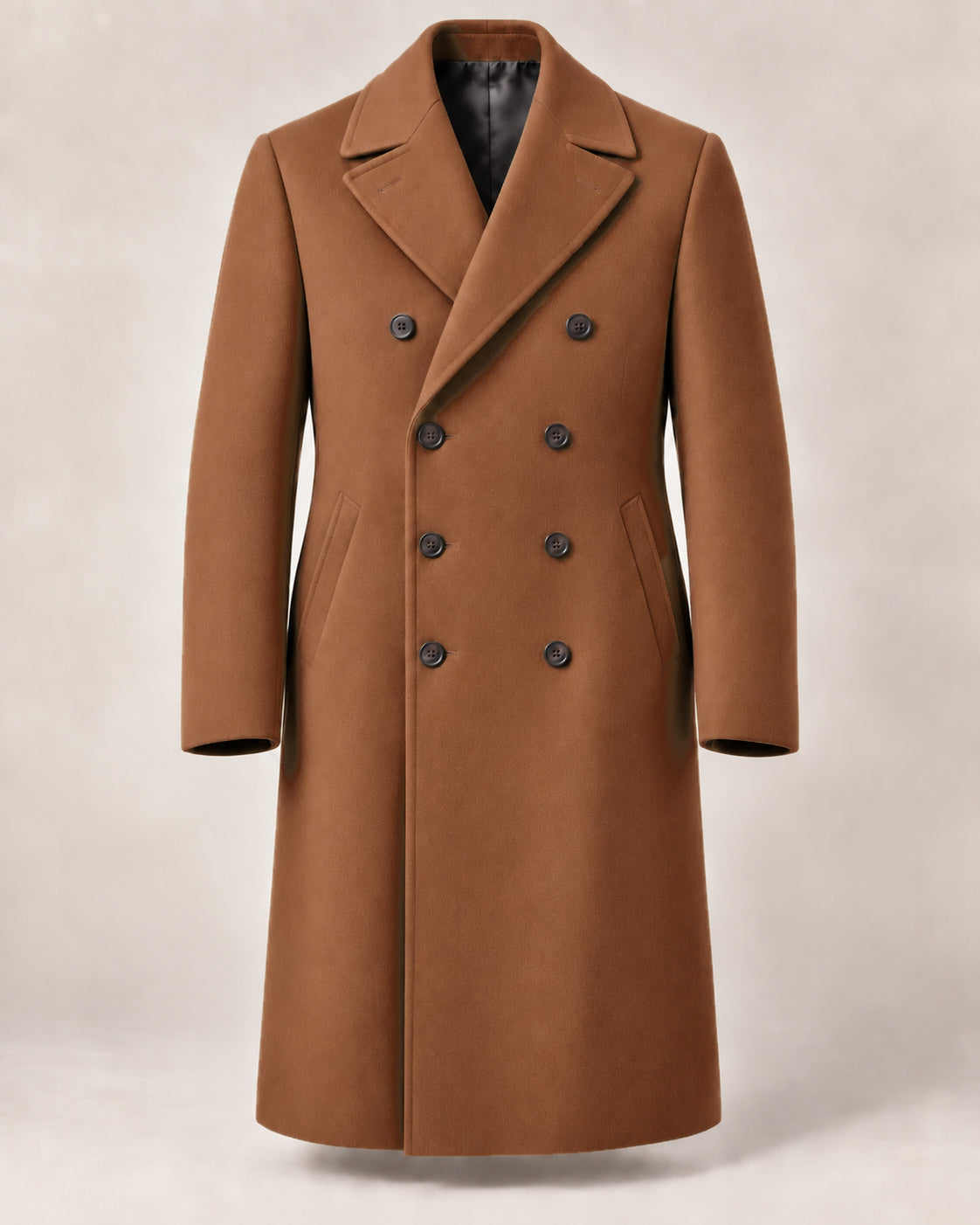
From $31,000 for the single-breasted, knee-length coat in 420 g. Your price follows the cloth weight, the cut and the length. It includes the cloth, your measure, the toile, full silk lining and horn buttons, the making in Landshut and your provenance file. Payment in full with your commission.
10
How is your coat made?
In conversation, we choose the cut and the cloth. We take your measurements in person in Landshut, or by video with Yeşim Küçükay. On the toile, a fitting garment in cotton, we settle posture, length and freedom of movement — only then do we cut the vicuña. Your proposal states the lead time.
Sources
- IUCN SSC South American Camelid Specialist Group (GECS) — range 3,200 to nearly 5,000 m; around 10,000 animals in the mid-20th century; Least Concern since 2008
- Pacheco et al. 2019 — fibre diameter and fleece weight, Cusco region (302 samples, 633 fleeces)
- Dirección Regional Agraria Ayacucho, 18 Sep 2023 — around 200 g of fibre per animal, every three years
- Mecardo (A. Woods), 28 May 2024 — around 7 t exported a year; raw fibre around three times good cashmere
- DNFI, Cashmere (data: FAO 2009, DNFI 2020) — 150 g of underdown per animal a year; top quality 14 µm; 6,500 t of pure cashmere; China, Mongolia
- Scabal, fabric catalogue (bunch C1801 “Pure Vicuna”) — 100% vicuña, 420/520 g per running metre, twill, yarn-dyed, selvedge
- Regulation (EU) No 1007/2011, Annex I, No 2 — fibre name “vicuña” in EU labelling
- 50 CFR 17.40(m) and 23.75(f) — USA: fibre from live shearing; CITES document even for personal effects; selvedge with country of origin
- Regulation (EU) 2026/1383, Annex — vicuña: populations in Peru, Bolivia, Argentina, Chile, Ecuador; label “VICUÑA [country of origin]”
- Wool Products Labeling Act, 15 U.S.C. § 68b(a)(6) — cashmere: mean fibre diameter of at most 19 µm
- SPDA / Actualidad Ambiental, 5 Apr 2024 — Peru: 208,899 vicuñas (2012 census), 67,821 (1994); chaccus authorised by regional governments
- Council Regulation (EC) No 338/97, Art. 5(4) and Art. 8(5) — re-export certificate on export; sale within the EU with evidence of origin
- California Penal Code § 653o — California: commercial sale of vicuña prohibited